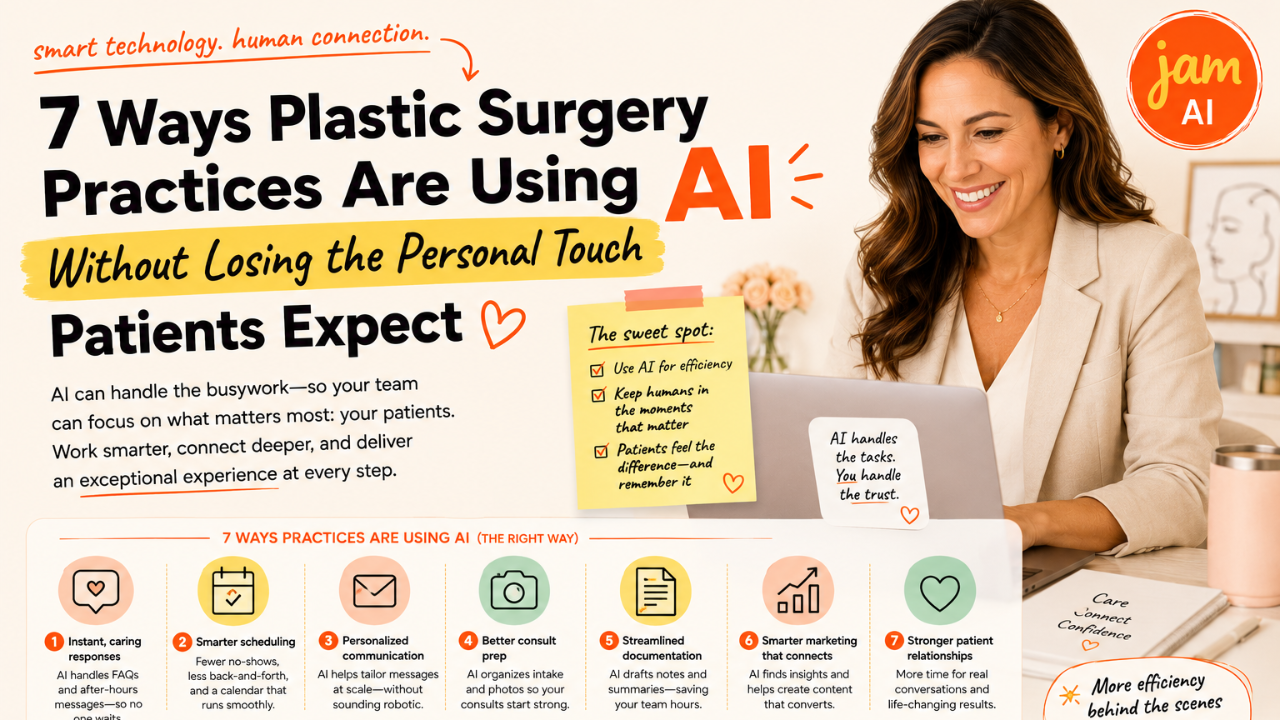
7 Ways Plastic Surgery Practices Are Using AI Without Losing the Personal Touch Patients Expect
May 14, 2026Patients choose a plastic surgeon the way they choose a partner. They research for months. They read every review. They scroll your Instagram before they ever fill out a form. By the time they walk in, they know your name, your work, and your team.
The practices that win this attention war aren't the loudest. They're the most responsive, the most educational, and the most consistent. That's exactly what AI is built for, when you use it right.
In this post you'll see 7 ways plastic surgery practices are using AI to handle the high-volume work without losing the high-touch experience patients expect. Specific plays. Real numbers. Built around HIPAA from day one.
The Same 20 Questions, 100 Times a Day
Every plastic surgery practice gets the same questions on repeat. How long is recovery? Do you offer financing? Can I see before-and-afters? What's the difference between you and the practice down the street? Your front desk answers them constantly, and every minute spent answering them is a minute not spent on the higher-value patient experience.
AI can handle 50 to 70% of inbound questions automatically. Done right, the patient feels like they got a thoughtful, fast response. Your team gets their day back.
1. A Patient FAQ Bot Trained on Your Practice
Use a HIPAA-compliant chatbot (not consumer AI) trained on your practice's information: services, recovery timelines, financing options, surgeon bios, and your most common questions.
Patients get instant, accurate answers 24/7. Anything complex or clinical gets escalated to a human. The shift: your team stops answering the same 5 questions and starts having real conversations with serious prospects.
2. Consult Follow-Up That Feels Personal at Scale
This is the highest-ROI play in aesthetics and plastic surgery. After every consult, your coordinator enters the patient's procedure of interest, the surgeon they saw, and 1 to 2 personal notes from the visit.
AI drafts a personalized 24-hour follow-up, a 7-day check-in, and a 21-day soft re-engagement. Each message references the actual procedure and the actual conversation. Practices using this see 25 to 40% lifts in consult-to-booking conversion within 60 days.
3. Pre-Op and Post-Op Instructions That Actually Get Read
Most patient instructions are generic, long, and ignored. AI can produce personalized versions in seconds.
Feed AI your standard protocol for a procedure and add the patient's specifics (age range, lifestyle, concerns). Ask for a friendly, easy-to-follow instruction sheet at a 6th grade reading level. Have a clinician review and approve the template once.
Compliance goes up. Recovery complications go down. Patient satisfaction scores tick up across the board.
4. Educational Content That Builds Trust Before They Book
The surgeons who dominate Instagram aren't the ones with the most before-and-afters. They're the ones who educate. AI lets you publish 3 to 4 educational pieces a week without spending hours writing.
Try this: "Write a 60-second video script explaining the difference between a deep plane facelift and a SMAS facelift in plain language. Add a hook, a teaching moment, and a soft CTA to book a consult."
Hook, teach, CTA. Done in 90 seconds. Have your surgeon review for accuracy before recording.
5. Review Responses at Scale
Plastic surgery is a review-driven industry. Practices that respond to 100% of reviews grow review volume 2 to 3x faster than practices that don't.
AI drafts personalized responses to every review in minutes. You edit lightly and post. This single workflow protects your reputation while freeing your team from one of the most-dreaded admin tasks.
6. Lead Nurture Sequences That Pre-Sell the Consult
When a prospect fills out the "request a consult" form, most practices send one confirmation email and go silent until the appointment. The good practices have a 5 to 7 message nurture sequence that does the trust-building work before the consult.
AI writes the entire sequence in an hour: confirmation, what to expect at your consult, video introducing the surgeon, 2 to 3 patient stories, financing information, and a final pre-consult reminder.
Patients show up warmer. Consults convert better. Cancellations drop.
7. The HIPAA Foundation You Cannot Skip
This part matters more for plastic surgery than for almost any other practice type, because the data is so identifiable.
- Use enterprise AI tiers (Claude for Work, ChatGPT Enterprise) with signed Business Associate Agreements.
- Use HIPAA-compliant CRMs for any automation touching patient data.
- Strip PHI when using consumer AI. "Female, mid-40s, interested in rhinoplasty" is fine. Names, photos, and identifying details are not.
- Train your team on what is and isn't safe to enter into AI tools. One mistake can be expensive.
This isn't a reason to avoid AI. It's a reason to set it up properly from day one.
Where to Start If You Only Have a Week
You don't need to overhaul your practice. If you have one week:
- Day 1 to 2: Build your consult follow-up workflow. Single highest ROI play.
- Day 3: Train a HIPAA-compliant chatbot on your top 20 FAQs.
- Day 4 to 5: Set up your review response template.
By week's end, you have measurable time savings AND measurable conversion lift. That's the move.
Frequently Asked Questions
Can AI handle patient questions for a plastic surgery practice?
Yes, for the high-volume repetitive questions. AI can handle inquiries about recovery time, financing options, before-and-after photos, what to expect at a consult, and general procedure information. Complex medical questions and personalized clinical guidance should always be routed to a clinical staff member. Most practices report AI handling 50 to 70% of inbound questions automatically.
Is AI HIPAA compliant for plastic surgery practices?
Consumer AI tools are not HIPAA compliant. Practices should use enterprise versions (Claude for Work, ChatGPT Enterprise) with a signed Business Associate Agreement, or work with HIPAA-compliant CRMs and automation platforms designed for medical practices. Never enter patient names, photos, or PHI into a consumer AI tool.
How can plastic surgery practices use AI to convert more consults?
The biggest gain is structured AI-powered consult follow-up. After every consult, staff enter the patient's procedure of interest and a few personal notes; AI drafts a personalized follow-up sequence (24-hour, 7-day, 21-day). Practices using this play see 25 to 40% lifts in consult-to-booking conversion within 60 days.
Can AI help with patient education content?
Yes. AI can draft pre-op instructions, recovery guides, blog posts, social media educational content, and explainer videos in seconds. Always have a clinician review the content for medical accuracy before publishing. Practices that publish educational content consistently rank higher in search and build trust faster with prospective patients.
Will AI replace front desk staff at a plastic surgery practice?
No. AI handles repetitive admin work so the front desk can focus on what matters: greeting patients warmly, navigating complex requests, and protecting the practice's brand experience. The practices that win use AI to elevate their team, not replace them.
How much does AI cost for a plastic surgery practice?
A basic AI stack for a plastic surgery practice runs $200 to $500/month: enterprise AI for content and follow-up, a HIPAA-compliant chatbot for FAQs, and a CRM with automation. Larger practices add review management and ad creative tools. Most see ROI in the first quarter from increased consult conversions alone.
Ready to Put This to Work?
Your patients are choosing you for the experience as much as the surgical skill. AI is how you protect that experience while scaling it.
Ready to put AI to work in your practice? Grab Jam's free AI Starter Toolkit at jamout.ai and start saving time this week. 🧡
Build Your Business with AI — Even If You’re Overwhelmed, Busy, or Just Starting Out
Club Jam gives you the tools, training, and AI team to launch, automate, and grow your business — all for $47/month. No tech confusion. Just fast wins.
Not sure where to start? Let us help you by doing a consult. We can help you identify areas within your business that can be automated.
We hate SPAM. We will never sell your information, for any reason.